



I hadn’t originally planned to watch Sitaare Zameen Par. I was at the cinema to watch Final Destination, when the trailer for this film unexpectedly caught my eye. Something about it gave me a good feeling — and I decided to give it a shot.
What you’re about to read isn’t a generic review. It’s a personal reflection — rooted in my perspective, my emotional observations, and some psychological insights that stood out to me, as a psychology student. So yes, this review might be a little different — and definitely more introspective than usual.
Apparently, what unfolded on screen was far more than just a film — it was an echo of unspoken emotions, unsung resilience, and the unapplauded “normals” of life.
At its core lies the powerful message: “Sabka apna apna normal hota hai.”
Neurodivergent adults are coached by Gulshan (played by Amir Khan) — a man who, while guiding others toward acceptance, is still avoiding his own emotional shadows. His silence with his wife speaks volumes about how dialogue (or the lack of it) shapes us in countless ways.
(P.S.- I’m posting soon on the importance of dialogue in different dimensions — will hyperlink it when live!)
The man who shelters these adults delivers one of the most thought-provoking lines of the film — a stark reminder of how fragile and arbitrary our sense of “normal” is.


Image courtesy- https://en.wikipedia.org/wiki/File:Sitaare_Zameen_Par_poster.jpg#/media/File:Sitaare_Zameen_Par_poster.jpg
5 Reasons You SHOULD Watch It
1. It challenges the way we define “normal.”
The film revolves around neurodivergent adults, each of whom behaves in ways society often misunderstands. It asks: Why is sky-gazing celebrated, but another unique pursuit judged as “weird”? Why do we struggle to see authenticity when it doesn’t match our frame of reference?
Actually, I may have something to add on to this….. Lacking the ability to recognise the perspective of others is also referred to as apathy, but that’s considered normal, why? Because the environment is flooded with close-minded beings who lack time to look within but have plenty of time to count the reasons for judging others. Well ironically, apathy is often a symptom in several psychological disorders. And yet, society normalizes it, while questioning the “normalcy” of someone simply expressing themselves differently. If indifference is tolerated, why must authenticity be scrutinized and caged?
2. It reflects deep emotional and psychological healing.
This isn’t just about learning sports — it’s about overcoming past trauma. A student’s fear of water, a coach’s childhood abandonment, another’s betrayal by a mentor — every emotional thread speaks to something deeper. You won’t see over-the-top drama, but if you’ve ever done inner work, you’ll recognize these quiet turning points.
3. Shadow Work and Ego Defenses are subtly depicted by every Character
As someone who attempts shadow work, I found this film unexpectedly personal. It shows how our fears hide in plain sight — in fears of lifts, in avoidance of connection, in silence with loved ones. And how, sometimes, healing arrives not from therapists, but from the very people we set out to help.
I also found a glimpse of other ego defense mechanisms, as we call them in psychology. In projection of past betrayal leading to present mistrust in trustworthy people. The coach himself embodied suppression and avoidance, distancing himself from emotional intimacy — especially with his wife and the idea of fatherhood. His fear of elevators could be seen as displacement, redirecting childhood trauma onto a symbolic object.
At times, characters relied on intellectualization, focusing on logic over feeling — especially Gulshan, who initially treated his role more as a task than a connection. Denial appeared when certain emotional realities were brushed aside or ignored. Each of these defenses quietly shaped the emotional journeys of the characters, making their eventual breakthroughs all the more meaningful.
4. The neurodivergent characters show us real emotional intelligence.
There’s a moment where the coach says, “We have to defeat them badly,” and a player gently corrects him: “We’re not here to humiliate anyone.” That clarity, that heart — it’s one of the many times the players become the true teachers in this film.
To me, these scenes are illustrative of how we invite our misfortune when we judge people, because if we keep ourselves open, we can gain intensive life lessons from the most unexpected or ‘judged’ people.
5. It ends not with a win, but with Grace — and That’s a Lesson We All Need Right Now
Without giving spoilers: the final scenes remind us that effort matters more than victory. Joy doesn’t come from a trophy, but from connection, pride, and celebrating others. The adults in this film cheer even in defeat — with more sincerity than most winners.
In a world that constantly equates success with applause, we forget the quiet power of simply showing up, of giving our all, of learning through the journey. This film gently reminds us that external validation is loud, but self-respect is steady.
“We chase the world’s claps, yet miss the echo of our own becoming.”
It also echoes a profound truth we often overlook — the importance of detachment from outcomes. Much like the Bhagavad Gita teaches:
“कर्मण्येवाधिकारस्ते मा फलेषु कदाचन।” Karmanye vadhikaraste ma phaleshu kadachana — “You have the right to perform your actions, but not to the fruits thereof.”
This film doesn’t just entertain — it whispers timeless wisdom: to act with integrity, to strive without obsession, and to find peace regardless of the result. And honestly, in a society so consumed by performance and perfection, that reminder couldn’t be more relevant.
On the flip side….. no movie has the ability to resonate with everyone alike, and so may be the case with Sitaare Zameen Par. So here are 5 reasons why Sitaare Zameen Par may not be a preferable watch for everyone.
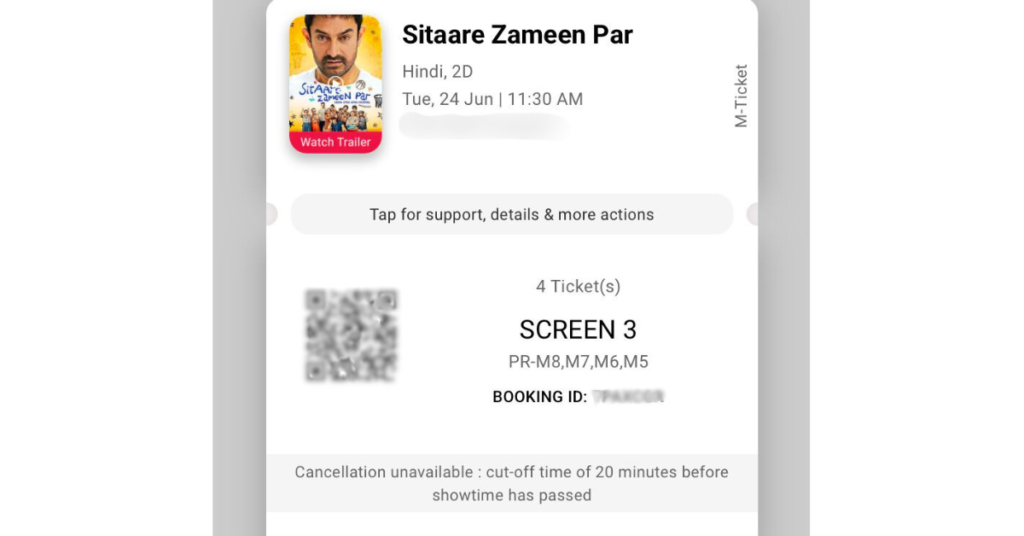
Snapped this after booking — just in case you thought I was reviewing from my couch instead of row M!
🚫 5 Reasons It MAY NOT Be For You
1. If you prefer fast-paced, multi-plot thrillers.
This film takes its time. The silences are intentional. The story breathes. If you enjoy plot twists, thrillers, or multiple interwoven arcs, this may feel slow or “uneventful.”
And honestly, sometimes that has less to do with the film itself — and more to do with the zone you’re in as a viewer. We all go through phases: sometimes we seek intensity, chaos, or epic scale — like Interstellar, Jurassic Park, or war dramas. But this film leans into patience, introspection, and quiet inner work — something you might only connect with if you’re in that emotional headspace.
2. If you’re looking for fiction, fantasy, or spectacle.
There are no dinosaurs, space missions, or horror sequences here. It’s emotionally intense, but visually grounded. Those seeking high-concept storytelling might feel underwhelmed.
And sometimes, it’s just about timing — when you’re in the mood for grand scale or escapism, a grounded, human-centered story may not land. This film resonates best when you’re open to subtleties, not visual spectacle — grand sets, VFX-heavy scenes, massive plot turns, or dramatic battles — this may feel too subtle or minimal.
Again, sometimes it’s also simply about timing — when you’re in the mood for scale, drama, or escapism, a grounded, human-centered story may not land. This film resonates best when you’re open to quiet truths, not explosive moments.
3. If you’re uncomfortable with emotional vulnerability.
The characters express themselves in non-traditional ways — through body language, silence, or subtle gestures. The emotional language of the film is often unspoken — and that may feel unfamiliar or even uncomfortable if you’re used to more explicit storytelling.
That is completely fine too. It doesn’t mean you don’t enjoy deep thinking or layered storytelling — not at all. It simply reflects that movies are also a space for unwinding, and many viewers come seeking lightness, thrill, or escape. So, even if you’re not comfortable sitting with the kind of quiet vulnerability this film presents, that’s completely valid — and certainly not a limitation. It’s just a reflection of what you’re emotionally seeking in that moment.
4. If you’re expecting surface-level inspiration.
This isn’t the kind of “inspirational” film with long loud speeches and dramatic breakthroughs. It deals with discomfort, emotional restraint, and healing through subtlety.
So if you’re expecting a sequel to Taare Zameen Par, it’s important to note: this film follows a different emotional route — less about discovery, more about inner reconstruction. It doesn’t spoon-feed emotional payoff — you have to feel your way through it.
If you’re in a headspace that craves quick upliftment or clear resolutions, this might feel emotionally heavy. It asks for patience, not applause. The film asks you to sit with stillness — something not everyone seeks all the time, and that’s completely valid.
5. If you’re bothered by remakes or story parallels.
Sitaare Zameen Par is an official remake of the 2018 Spanish film Champions. While I haven’t watched the original myself, the remake nature might affect the viewing experience for those who strongly prefer fresh, never-seen-before plots. Although, Sitaare Zameen Par adds cultural depth and psychological nuance, if you’re a stickler for originality, this might hold you back from fully engaging.
Conclusion
In a nutshell, Sitaare Zameen Par isn’t just a film — it’s a mirror for those willing to pause, reflect, and feel. Whether it aligns with your current zone of mind or not, it holds a quiet power for anyone open to embracing difference, depth, and emotional honesty.
Not every film is meant to entertain — some are meant to gently stir the waters within. This post is my experience — maybe yours will differ. But sometimes, it’s in the difference that we discover our own “normal.”